Sharpen Your Tactics.
Build True Mastery.
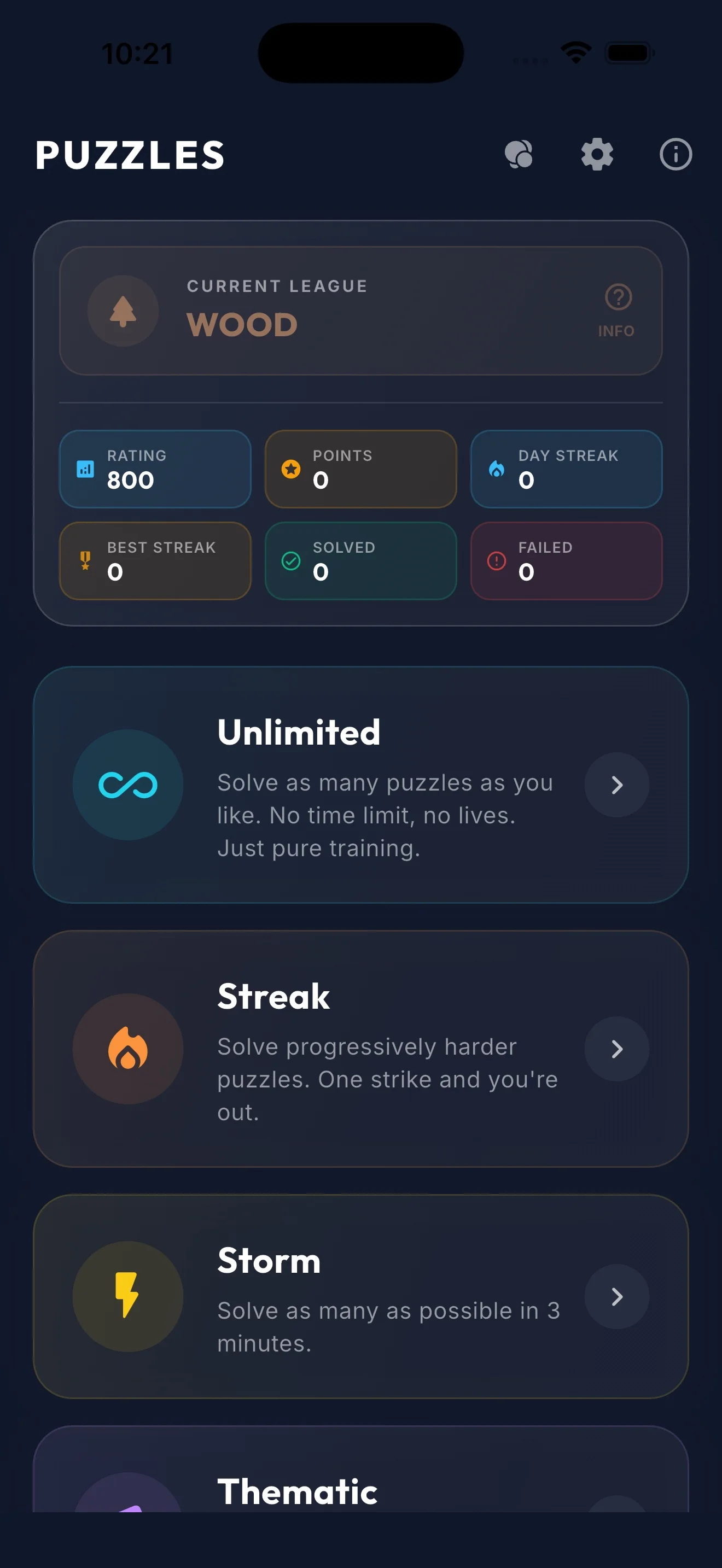
Six specialized training modes, a Glicko-2 rating system, and spaced repetition. Your progress stays on your device. No account required to play — online leaderboards available when you want them.
Six Ways to Train
Each mode sharpens a different dimension of your tactical skill, rated and tracked entirely on-device.
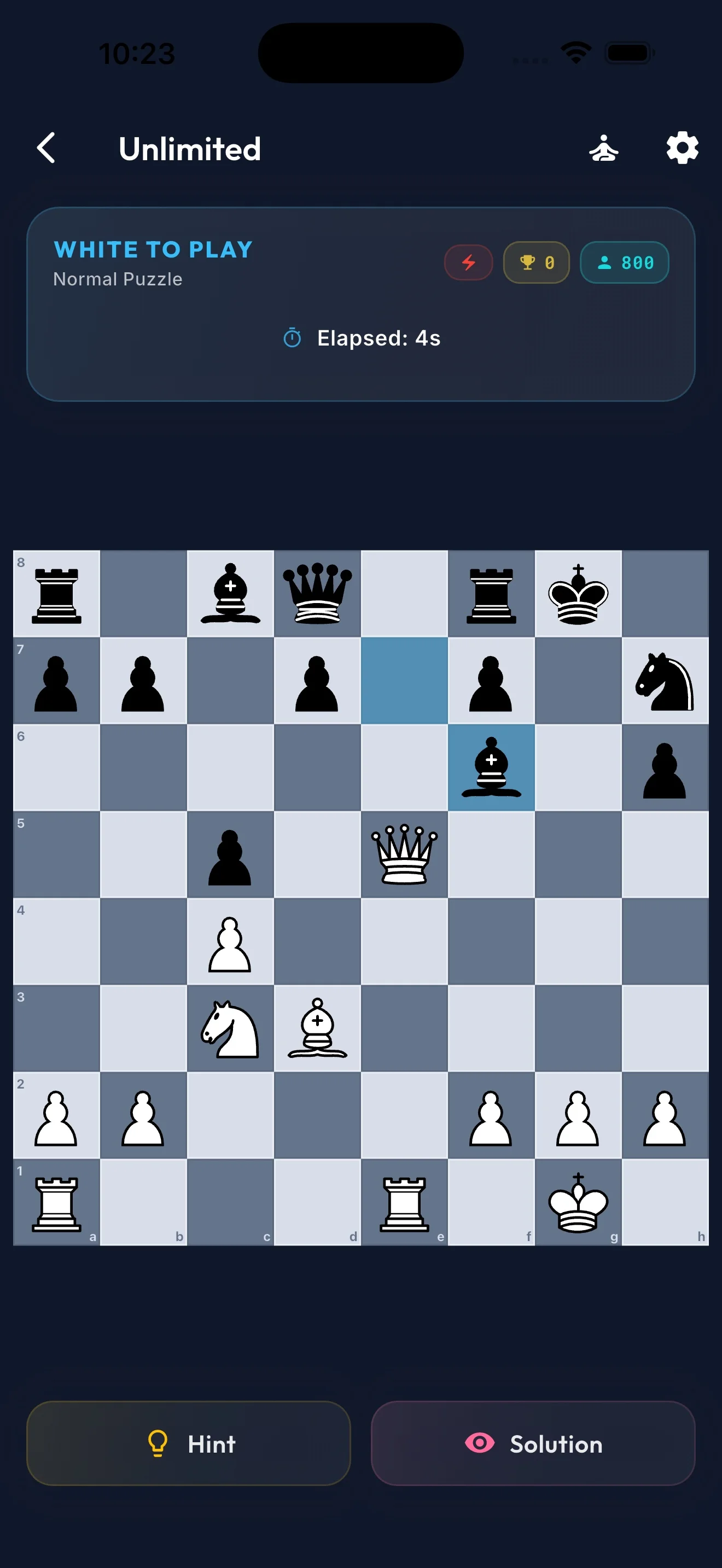
Unlimited
Work through an endless queue of puzzles matched closely to your current rating. No time limit, no lives, no pressure. Each puzzle is selected so the difficulty sits in a zone where you're genuinely challenged but not overwhelmed. Solve correctly and your rating rises; fail and it drops a little. The best mode for daily practice, warming up, or simply enjoying puzzles at your own pace.
Streak
Build the longest run of consecutive correct solves you can. The mode moves through four escalating phases: an easy warm-up well below your rating, two increasingly demanding middle phases, then a final phase where puzzles can be up to 400 rating points above your level. One wrong move ends your streak immediately. No lives, no second chances. Your best score is saved permanently, making this the ideal mode for testing focus and consistency.
Storm
Race the clock: solve as many puzzles as possible before the timer hits zero. You start with 3 minutes and 3 lives. Every correct answer in a row, without using a hint, adds 3 seconds back to the clock, so a long combo can meaningfully extend your run. Using a hint or failing an answer costs a life. Lose all three and the run ends even if time remains. Your highest puzzle count is saved as your personal record.
Thematic
Pick a specific tactical motif (fork, pin, skewer, back-rank mate, discovered attack, zwischenzug, and many more) and drill it exclusively. Every puzzle is filtered to match both your chosen theme and your current rating band, so difficulty stays appropriate no matter which motif you pick. The app tracks your accuracy per theme independently, letting you see over time exactly which patterns you master and which ones keep tripping you up.
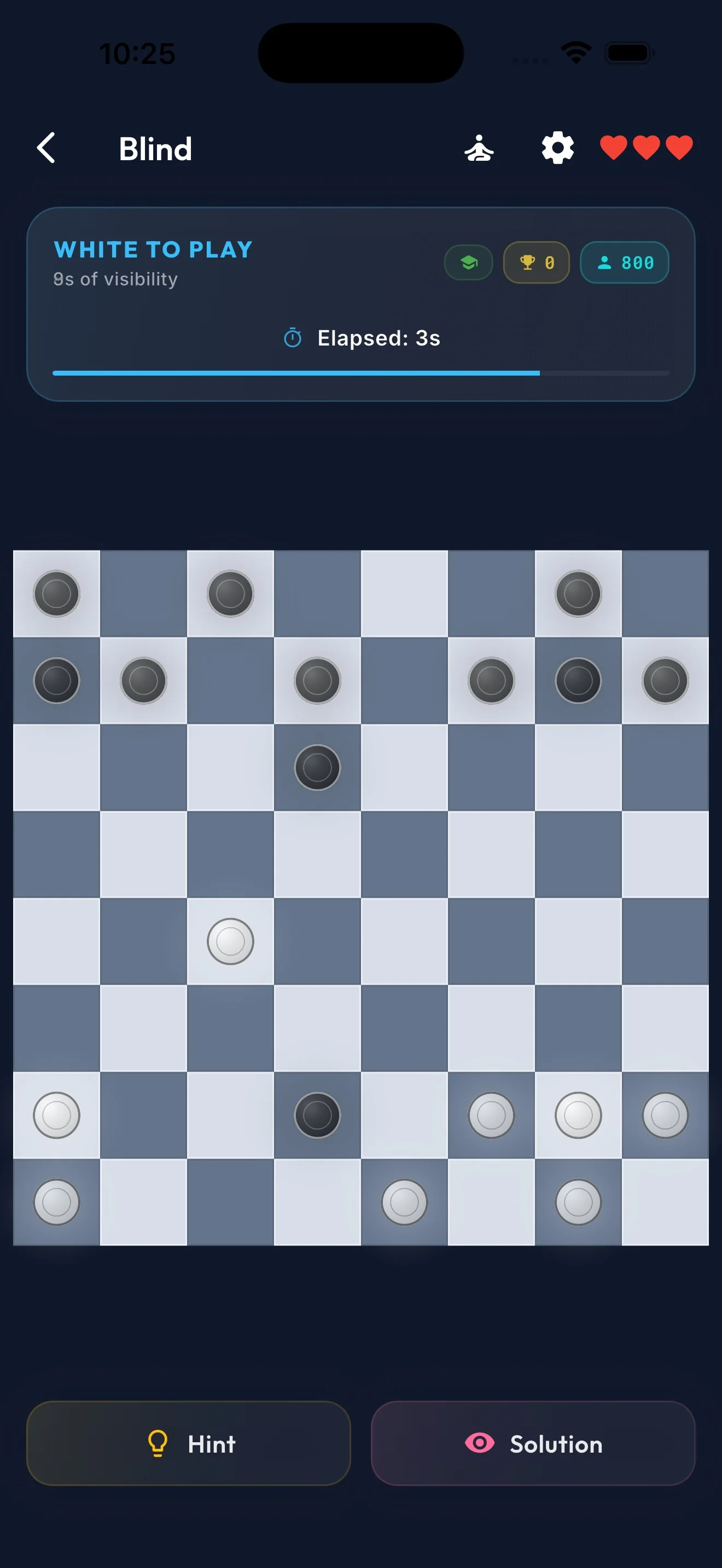
Blind
The position appears for a brief window (longer for positions with more pieces), then the board goes blank and you must solve it entirely from memory. No pieces to look at, only your mental image of the position. This mode directly trains board visualization and the ability to calculate variations ahead without a physical reference. Even short daily sessions produce measurable improvement in how far ahead you can see.
No Tactic
Half the positions you see contain a genuine winning tactic; the other half are quiet, non-forcing positions where the right move is simply a solid improving move. You must decide which type you're looking at before attempting a solution. This trains the discipline of not forcing a tactic just because one seems to be there, which is a common source of blunders in real games. Positions are chosen to be genuinely ambiguous: no obvious mates, no material wins sticking out at a glance.
Built to Last
The fundamentals that make every session feel effortless.
Your Data, Your Device
No account required to play. Every puzzle, rating update, and progress record is stored locally on your device, so the full training experience works without any internet connection. Online leaderboards are available as an optional feature when you want to compare your progress with others.
Six Beautiful Themes
Choose from six hand-crafted color schemes: Electric Blue, Forest, Blossom, Harvest, Onyx, and Walnut. Each theme is applied throughout the entire UI, including the board.
Every Platform
A single consistent experience across all five platforms. Mobile-first design that scales naturally to larger screens without losing any functionality.
Progress You Can Measure
Every session advances your standing across three independent tracking systems, each designed to give you an honest picture of where you stand and where you're improving.
Glicko-2 Rating
Your puzzle rating is a number that estimates your tactical strength. Think of it as a skill score. Solve a puzzle correctly and it goes up; fail one and it drops a little. The amount it moves depends on the puzzle's difficulty relative to yours: beating a puzzle rated much higher than you earns a bigger boost, while failing a hard puzzle hurts less than failing an easy one.
Alongside your rating is a second value called Rating Deviation (RD). Think of RD as a confidence window. When you're new, or after a long break, your RD is wide, meaning the system hasn't seen enough of your play to be certain of your true level. As you play more consistently, the window narrows and your rating becomes a reliable, stable measure. A low RD means your number can actually be trusted.
League & Points
Every puzzle you solve earns league points, a separate number from your rating that only ever goes up, never down. Points are awarded based on puzzle difficulty: a puzzle rated well above your level is worth significantly more than an easy one.
Consecutive correct solves without using a hint build a combo. At two correct answers in a row you hit the maximum 2× multiplier, meaning every subsequent correct solve in that run earns double points. One wrong answer or one hint resets the combo back to 1×, so staying clean matters.
Points accumulate across your entire lifetime in the app. Once you cross the threshold for the next league, you advance permanently. There is no demotion. Legend is the top rank and reflects a genuine, sustained investment in training.
Spaced Repetition
When you solve a puzzle for the first time it enters your personal review schedule. It comes back after 4 hours. Solve it correctly again and the next wait roughly doubles: then about 1 day, then 3 days, then 1 week, and so on, up to a maximum of 6 months at level 8. A puzzle that reaches level 8 is considered mastered.
If a returning puzzle comes back and you fail it, the interval resets completely to level 1 and the 4-hour cycle starts over. This keeps you honest: vague familiarity with a position is not enough.
The practical effect: puzzles you genuinely know fade into the background and only resurface every few months, while puzzles you keep failing stay in regular rotation. Over time your daily review queue naturally shifts toward your real weak spots rather than wasting time on things you already own.
How Points Are Earned
League points measure your total training investment and never decrease. Here is exactly how each solve is scored.
Get Gambito Puzzles
Free to download on every platform. Start training immediately.




Help & Support
Do I need an account or internet connection to play?
No account is required to play. All puzzle data, ratings, and progress are stored locally on your device, and the full training experience works without an internet connection. The one exception is online leaderboards, which need a connection to sync your scores with other players. Everything else works offline from first launch.
How does the rating system work?
Gambito Puzzles uses the full Glicko-2 algorithm. Your rating is a number that reflects your puzzle-solving strength. It goes up when you solve correctly and down when you fail. The important part is that the size of the change depends on difficulty: beating a puzzle rated much higher than yours earns a bigger boost than beating an easy one, and failing a hard puzzle hurts less than failing an easy one. Alongside your rating is a Rating Deviation (RD), a confidence window that shrinks the more you play. A high RD means the system is still calibrating you; a low RD means your rating is a reliable estimate of your true level.
What is spaced repetition and how does it work here?
Spaced repetition is a scheduling method that brings puzzles back at increasing intervals based on whether you solve them correctly. The first time you solve a puzzle it is added to your review queue and returns after 4 hours. Solve it correctly again and the next interval roughly doubles: then around 1 day, 3 days, 1 week, and so on up to 6 months at level 8 (mastered). If you fail a returning puzzle, the interval resets to level 1 and the cycle restarts from 4 hours. The result is that puzzles you truly know disappear almost entirely from your daily queue, while puzzles you keep missing stay in regular rotation, automatically focusing your time where it matters most.
How do leagues and league points work?
Every puzzle you solve, in any mode, earns league points. Points scale with difficulty: harder puzzles are worth more. Consecutive correct solves without using a hint build a combo multiplier, capping at 2× after two correct answers in a row. That means every solve in a clean run earns double points. One wrong answer or one hint resets the combo back to 1×. Points accumulate permanently and can never decrease. Once you cross the threshold for the next league you advance forever. There is no demotion. The five leagues in order are Wood, Stone, Bronze, Silver, and Legend. Each requires significantly more total points than the previous, and Legend represents a substantial, sustained training commitment.
Can I filter puzzles by tactical theme?
Yes, use Thematic mode. It lets you drill any specific motif such as fork, pin, skewer, back rank mate, discovered attack, and more. A fast search makes it easy to find the theme you want to work on, and the app tracks your accuracy per theme separately.
How does Blind mode work?
The puzzle position is shown briefly. The more pieces on the board, the longer the window. Then the board goes blank and you must play the solution from memory. It is one of the most demanding training modes and has a measurable effect on board visualization over time.
What can I configure?
Settings are accessible via the gear icon on the main puzzle screen and from inside any active puzzle mode. The panel covers four areas:
Difficulty — choose between Mixed, Standard, Hard, and Extreme to control the difficulty range of puzzles served to you across all modes.
Session behaviour — toggle Auto-advance (move to the next puzzle automatically after solving), Show timer (display elapsed time while solving), and Enable 3-Strikes Limit (end the session after three mistakes).
Appearance — pick one of the six color themes. The theme applies to the entire UI including the board.
Sound & feedback — toggle Sound Effects (play sounds on moves) and Haptic Feedback (vibrate on interaction).
Why wasn't my Storm or Blind high score recorded?
Storm and Blind high scores are only registered when the session was played under standard settings. For Storm, this means the duration must be set to the default 3 minutes and the 3-Strikes Limit must be enabled. For Blind, the Max Blind Pieces slider must be at 20 or above (the default) and strikes must be enabled. Sessions with a longer duration, a reduced piece cap, or strikes disabled will still count toward your league points, but the puzzle count won't update your personal best or submit to online leaderboards. This keeps scores comparable across players. Streak mode is always eligible because its strikes setting cannot be turned off.
How do I contact support?
Email us at support@gambitochess.com.